

From ThinkingData to ThinkingAI: A Decade-Old Chinese SaaS Founder Bets His Next Ten Years on AI Agents
On rebranding, relocation, and what it actually takes for a Chinese B2B company to land in Silicon Valley — with Chris Han, co-founder of ThinkingAI.

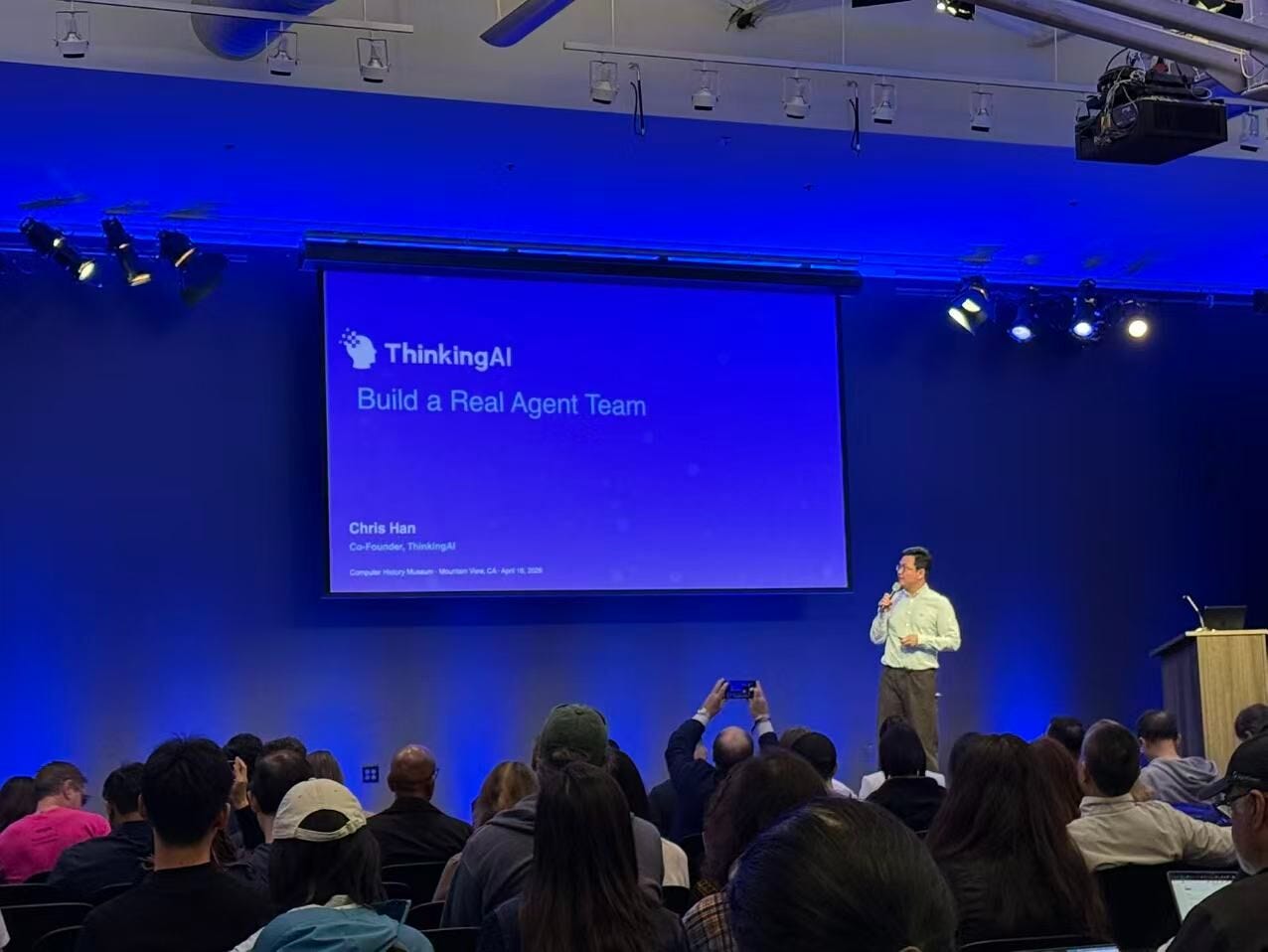
In 2026, almost every tech company is renaming itself. Some have appended “.md” to their company name. Some have grafted “AI” onto a product line. Some have simply repackaged themselves as “an Agent for X.” It is, by now, a recognizable tic of the cycle.
When I sat down with Chris Han, co-founder of ThinkingAI — formerly ThinkingData, and known in China as 数数科技 (Shù Shù Kē Jì) — I expected another version of that conversation. A rebrand. A new product line. The standard 2026 playbook.
What I got instead was something more interesting: a founder who has spent eleven years building one of China’s earliest and most established gaming-data SaaS companies, walking through, in some detail, why he believes the entire foundation of his industry has shifted — and why the right response is not a marketing refresh but a full product-level rebuild.
The new product is called Agentic Engine, currently at version 6.0. The company name change reflects what is, in his telling, a more fundamental bet: that the next ten years of game operations will be agent-driven, not dashboard-driven.
This is not a small bet. ThinkingData has been the data-analytics backbone for a substantial portion of Chinese gaming over the last decade. Pivoting that customer base — and the underlying product surface — to agents is a category-defining move. It is also one that, if it works, has implications well beyond China.
The unlikely origin: from Intel engineer to Chinese SaaS Year Zero
Chris’s path into gaming data was indirect. He studied math as an undergraduate, software engineering in graduate school, and went on to work as a software engineer at Intel — closer to the metal than to the games industry. It was not gaming that pulled him in. It was the data problem.
In 2015 — what many in China later came to call the country’s SaaS Year Zero — he and three co-founders (two from Tencent, one from Shanda) started ThinkingData. Three of the four came from games. Chris did not. His angle was different: at Intel he had worked closely with game-industry ISVs because gaming was the most demanding workload to enable on new silicon.
That gave him a particular insight that has, in retrospect, defined the company. In the entire field of data services, gaming is structurally the hardest customer. The most complex scenarios. The largest data volumes. The widest dimensions. The deepest dependence on data. If you could build a system that worked here, working in adjacent industries — live-streaming, social, payments — would be comparatively easy.
Eleven years on, that bet has held. But Chris is the first to say it has held for reasons more cultural than technical.
The decade-long shift: from “art-driven” to data-pervasive
When ThinkingData first started selling into Chinese game studios, Chris was used to a specific kind of pushback. “I never look at data,” founders would tell him, often the most senior person in the room. “We’re an art-driven studio. We’re creative-driven. We are the players — why would we need to look at data?”
He says this without much irony. Then, after a pause: “Almost all of those people eventually became our customers.”
What changed wasn’t a sudden cultural awakening. It was structural pressure. After China’s 2018 license freeze (版号收紧) and the subsequent compression of mobile UA economics, the simple business logic of “good game + buy traffic” stopped working. Acquisition costs rose. Margins thinned. Operators had no choice but to instrument every link in the chain — from creative to attribution to retention to monetization — and to instrument it carefully.
Today, Chris says, you would be hard-pressed to find a Chinese game studio that doesn’t track and analyze every step of its operating funnel.
But he is honest about the deeper reason this took so long, and about the way it reflects a broader pattern in early-stage success. “When founders hit a streak, they tend to attribute the success to their own ability — that they were smart enough or worked hard enough,” he told me. “Most of the time, success comes from timing. From the era. Almost no one is destined to win.”
It is a notable thing to hear from someone whose company has been profitable for over a decade.
The most painful failure mode: when data shows up too late
I asked him what he sees, from his vantage point as a service provider, as the most common cause of game-project failure.
He hesitated. “I don’t want to evaluate other people. But what I have seen is something that has happened more often in the last two or three years.”
A studio invests two, three, sometimes more years into a project. Real money — sometimes a founder’s life savings. They get to soft-launch. The KPIs come in. The numbers don’t work. “And the day before launch, they tell us — we’ve decided to kill this project.”
Or it goes live, runs for a few months, and dies.
His diagnosis is precise: by the time data analysis surfaces fundamental problems at soft-launch, the changes required are often structural — a year or two of additional work, on a runway that no longer exists. The asymmetry is brutal: instrumenting earlier costs almost nothing, but the cost of not instrumenting compounds across the entire dev cycle.
His best customers — he names IGG and Diandian (点点) — are the inverse: they start with a small core idea, integrate analytics from day one, and let player data and feedback iteratively shape the product. “They roll a small snowball,” he says, “and they keep rolling it.”
The implication is uncomfortable for many founders. Data tooling is not a late-stage luxury for once-the-game-works. It is a project-survival mechanism.
The harder bet: relocating to Silicon Valley
In late 2024, Chris relocated to the United States. The other three co-founders are now distributed — one per major market.
The strategic logic is straightforward. A SaaS company exists to solve one problem: growth. Once you saturate a domestic market — and ThinkingData’s penetration in Chinese gaming is meaningful — you have two options. Go deeper. Or go wider. They chose wider, starting with Japan and Korea (closer culturally), then graduating to the US and Europe.
What they did not anticipate, Chris said with some humor, was how many of the obstacles would have nothing to do with the product.
“Honestly — we did not realize how many problems there would be. The visa. Whether you can stay long enough to actually build a team. Housing. Local hires. Contracts and legal. The fact that you have no local customer references — so why should anyone trust you with their data? Each of these is a step. Each step is a delay. You only feel the weight when you start walking.”
He talks about the cultural mechanics of Chinese B2B sales with a kind of wistfulness:
“In China, WeChat 公众号 is our most important content channel. New videos, new product news, exclusive pieces — everything goes there first. And pre-sales is mostly in person. ‘Brother, let me come visit you tomorrow.’ I might visit four or five companies in a single day, drink some tea, and trust gets built quickly. We have a saying — 见面三分情 — meeting in person already creates a bond.”
In the US, the rhythm inverts.
“In the US, you need a polished, powerful, complete website. LinkedIn is the most important social channel. New product announcements go on the website first, not anywhere else. And in-person meetings — those happen maybe once a year, at events like GDC. Pre-sales is essentially all online. We’ve been on calls where the customer has four or five decision-makers across different time zones, and we have six or seven people on our side, also across different time zones. Negotiating a contract through that is a different kind of work.”
There is also the simpler, more humbling fact: SaaS is, by birth, an American product category. Salesforce was founded in 1999. China’s SaaS market started about fifteen years later.
“You’re entering a market where the very thing you sell was invented. To pitch customers here, you have to be sufficiently niche. You need a real, distinctive value proposition. Otherwise there’s no reason for them to pick you over the local incumbent.”
His friends in the US told him before he came: be patient. Chris admits he didn’t fully internalize this until he was on the ground. “This work demands patience. There’s no skipping it.”
The product thesis: three pillars of Agentic Engine 6.0
If the rebrand is the headline, the actual product change is the substance. Agentic Engine 6.0 rests on three architectural decisions that, taken together, define how Chris thinks the next decade of game operations will work.
1. Private, on-premise deployment
This is the part most easily misunderstood. Customers have always said they were “giving their data to ThinkingData.” They were not. They were giving it to a system ThinkingData had deployed onto the customer’s own infrastructure. After eleven years, Chris notes, the company has no customer data of its own — outside a small SaaS slice. (This is also why ThinkingAI does not publish “industry reports” of the kind some analytics vendors are known for.)
The agentic layer inherits this architecture. Every agent runs locally, on the customer’s own servers. The data never leaves. In a regulatory and competitive environment where data sovereignty is increasingly load-bearing, this is not a marketing position — it is a foundational constraint that opens up applications others can’t credibly offer.
2. Structured + unstructured data, fused into a single decision surface
The traditional analytics product, including ThinkingData’s own previous generation, made decisions almost entirely on structured data. User behavior events. Attribution data. Tables, fields, schemas.
Agentic Engine pulls in the unstructured layer that game studios have always had but never had a way to systematically use:
Reddit and Discord discussions about your product
Internal meeting notes
Product design documents and concept sketches
Marketing creative — including the videos themselves
Player support tickets and community moderation logs
“These things, fused with structured data, surface decisions that no team has been able to surface before. Connections between things that previously had to wait for a human to notice them.”
This is, for those tracking the broader agentic infrastructure space, the most defensible technical bet in the product. Multi-modal grounding on private game data is non-trivial. The teams that have spent the most time inside game telemetry will have a head start.
3. Human-to-Agent replaces Human-to-Software
In the previous generation of the product, humans interacted with software. Read the dashboard. Build the dashboard. Launch a campaign. Build creative variants. Run an A/B test. Analyze the results. Roll forward.
In Agentic Engine, humans interact with agents:
An analysis agent that surfaces insights
A LiveOps engagement agent that recommends and launches campaigns
An A/B testing agent that runs experiments end to end
A customer-built agent layer that lets studios deploy their own (a financial agent, for example, that talks to the analysis agent and surfaces business signals together)
The argument for why agents will outperform humans here is unsentimental:
“How many dashboards can a person read in ten minutes? A studio has thousands of metrics, hundreds of dashboards. No human can fully cover them. An agent can. Faster, more thoroughly, more consistently.”
It’s worth noting that in version 6.0, the analysis-to-impact loop is already closed. The agent doesn’t just identify an insight. It proposes the next campaign. It drafts the experiment. The human stays in the loop to approve and audit, but no longer to do the assembly work.
“Atomic Opportunities”: Chris’s strategic frame
Chris uses a phrase, unprompted, that I think is the cleanest distillation of his thesis. He calls it “Atomic Opportunities.”
“In game operations there are enormous numbers of small opportunities. Each of them, taken individually, doesn’t move the needle much. But each one also has a tiny, tiny window of time in which it’s actionable. With humans alone, most of those windows close before anyone gets to them.”
Agents change the math. Once the loop from insight to impact is short enough — measured in minutes, not weeks — the entire surface of small, time-sensitive opportunities becomes addressable. And once that’s the case, what gets unlocked is not just operational efficiency, but a different shape of product strategy.
“What we want is for the product team to operate at the upper bound of its potential. Not bottlenecked by infra. Not bottlenecked by communication overhead. Not bottlenecked by team friction. Just — the team’s actual taste and judgment, applied to the actual product.”
When I asked him what the ideal end state looks like, he answered without hesitation:
“The problem gets solved before you even realize it was a problem. That’s where we’re trying to take the industry.”
What this means for the workforce
The natural follow-up question — one Chris said he gets often, from both customers and his own team — is whether this displaces operations roles.
His answer is more nuanced than the standard “AI augments humans” line:
“Anxiety is real. We feel it ourselves — every founder going through a transition like this does. But from what we’re hearing back from customers, in China, Japan, Korea, Europe, the US — the response is overwhelmingly positive. Studios want this. They see it as the most advanced productivity available to them right now.”
What he believes will become the scarce skill is something different than is usually named in these conversations. Aesthetic judgment. Knowing what you actually want.
“If you don’t know which direction you want to go, an agent can only fill in information. It can’t tell you where you should go. That’s something only the human knows. The people who will do well are the ones who have clarity about what they’re building, and who can give an agent good direction.”
It mirrors a phrase Chris likes — “revolution yourself before others revolution you.”
The corollary is sharper than it sounds. The studios that get this transition right will compound their existing advantages. The studios that don’t will fall behind quickly — and the gap will be hard to close, because the people who learn to operate this way will be more valuable than ever.
Closing: rationally pessimistic, or emotionally optimistic
Toward the end of our conversation, I asked Chris what advice he’d give to young people thinking about entering the game industry today.
He smiled.
“Don’t learn C++. Don’t learn Python. Learn to use Claude Code instead. My wife was telling me the other day, people are still learning C++ — and I told her, those people don’t need to. The basic logic-level coding work, AI does better. What you should learn is direction. Aesthetic. Judgment. If you have an idea, just go do it. Right now, with these tools, what used to be impossible is possible. Don’t waste time. Start now.”
When I asked him about whether, in this new era, he trusts machines or humans more — he gave the answer I think actually summarizes his view:
“It depends. For analysis, for statistics, for the rational work — yes, the machine does it better. Faster, more thoroughly, more deeply. But that makes the human relationships more precious. Not less. You and I are sitting here for over an hour, talking. That experience, with another person, becomes more valuable as agents become more capable. The interactions with agents will multiply. The interactions with humans will get rarer. So I treasure each of those much more than I used to.”
His personal credo, which he offered almost in passing, sticks with me:
“I would rather be emotionally optimistic than rationally pessimistic. Because if you live without hope, to me — that isn’t really living.”
For a founder rebuilding an eleven-year-old company, in a market where every decision is now shaped by the most disruptive technology shift in two decades, on a continent he’s lived on for less than two years — that is, perhaps, the only mental model that makes the work sustainable.
It’s also, looking at the trajectory of ThinkingAI’s bet, the kind of mental model that occasionally produces category-defining outcomes.
I’ll be watching closely.
ThinkingAI (formerly ThinkingData / 数数科技) is a Shanghai-and-Silicon-Valley-based gaming data and agentic operations platform, in market with version 6.0 of its Agentic Engine. Listen to the full conversation with Chris Han on the game bakery podcast, available wherever you get your podcasts.
If you enjoyed this piece, share it with someone working at the intersection of games, infrastructure, and AI — and let me know in the comments which part of the agentic stack you think will mature fastest.