

From Signals to Strategy
Merging Quantitative & Qualitative Data to Shape Product Roadmaps

Prelude — The Gap Between Insight and Action
At GDC this year, I shared a simple observation that, in hindsight, almost every product team is already living with: game teams today are drowning in signals. Signals from dashboards, signals from A/B experiments, signals from retention curves, and signals from community feedback. We measure almost everything, and yet despite this unprecedented visibility into player behavior, roadmap decisions are not getting easier. In many cases, they are becoming more difficult, more fragmented, and more contentious.
What stood out to me most were the follow-up conversations after the session. Many people told me that the framework resonated with how they intuitively think about product decisions, but when it came to actually applying it in their own teams, they felt stuck. This is not a problem of awareness; it is a problem of translation.
The patterns were consistent. Some teams struggled to combine qualitative and quantitative signals in a way that actually drives decisions, rather than simply generating insights that remain disconnected from execution. Others had strong qualitative understanding—player interviews, community insights, internal intuition—but leadership did not know how to interpret or trust those signals, so they never made it into roadmap discussions in a meaningful way.
What emerges from these conversations is not a lack of intelligence or effort, but a structural gap in how teams move from understanding to action.
That gap—between insight and action—is where most product organizations are quietly stuck, even if they don’t explicitly recognize it.
The Illusion of Data Maturity
If we look at the surface of modern game development, it is easy to conclude that we have entered a mature data-driven era. We have robust analytics infrastructure, real-time dashboards, sophisticated segmentation, and increasingly advanced experimentation frameworks. From a tooling perspective, the industry has never been more capable.
And yet, when you observe how decisions are actually made, the picture is less clear.
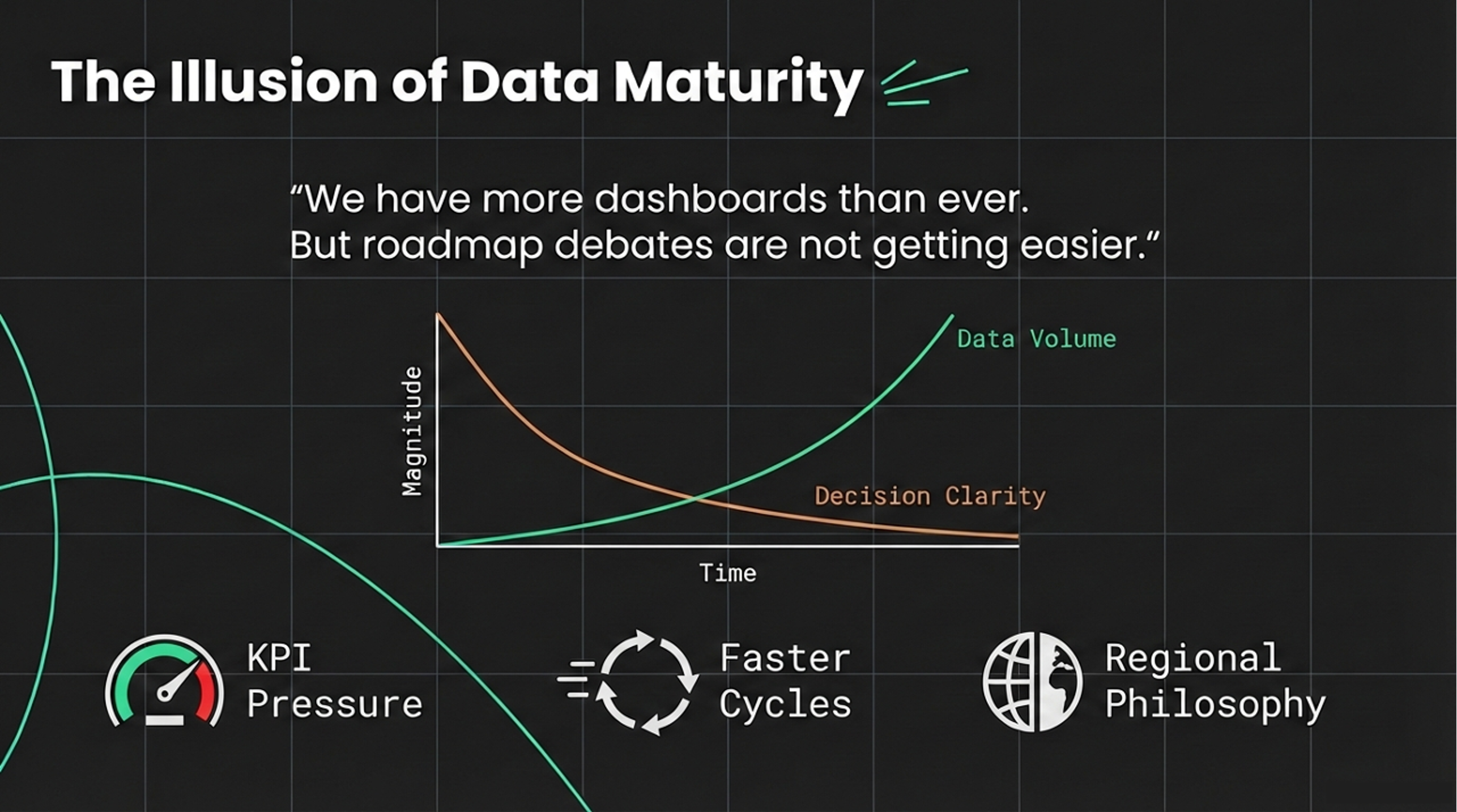
The paradox is that as data volume increases, decision clarity does not necessarily improve. In many cases, it deteriorates. Teams find themselves facing more signals, more interpretations, and more conflicting conclusions. The presence of data does not resolve disagreement; it often amplifies it.
This is why a familiar situation appears again and again in roadmap discussions. Analytics indicates that a feature is performing well. Design raises concerns about long-term experience degradation. Community feedback suggests dissatisfaction or friction. Meanwhile, revenue continues to trend upward. Each perspective is supported by valid evidence, and yet they point in different directions.
The difficulty in that moment is not about choosing which data is correct. It is about understanding what each type of signal represents, and how it should influence the decision.
We have become very good at measuring behavior, but we are still developing the ability to interpret meaning and translate it into direction.
The Trap of Pure Quant → Path Dependency
Quantitative analytics is indispensable. It gives us visibility into player behavior at scale and allows us to optimize systems with precision. Without it, modern live service games would not be possible.
But its strength also creates a subtle bias.
Quantitative data is inherently tied to observable behavior. It reflects what players are already doing within the system as it currently exists. When we rely heavily on these signals to guide decisions, we naturally begin to reinforce those existing patterns.
This is where path dependency emerges.
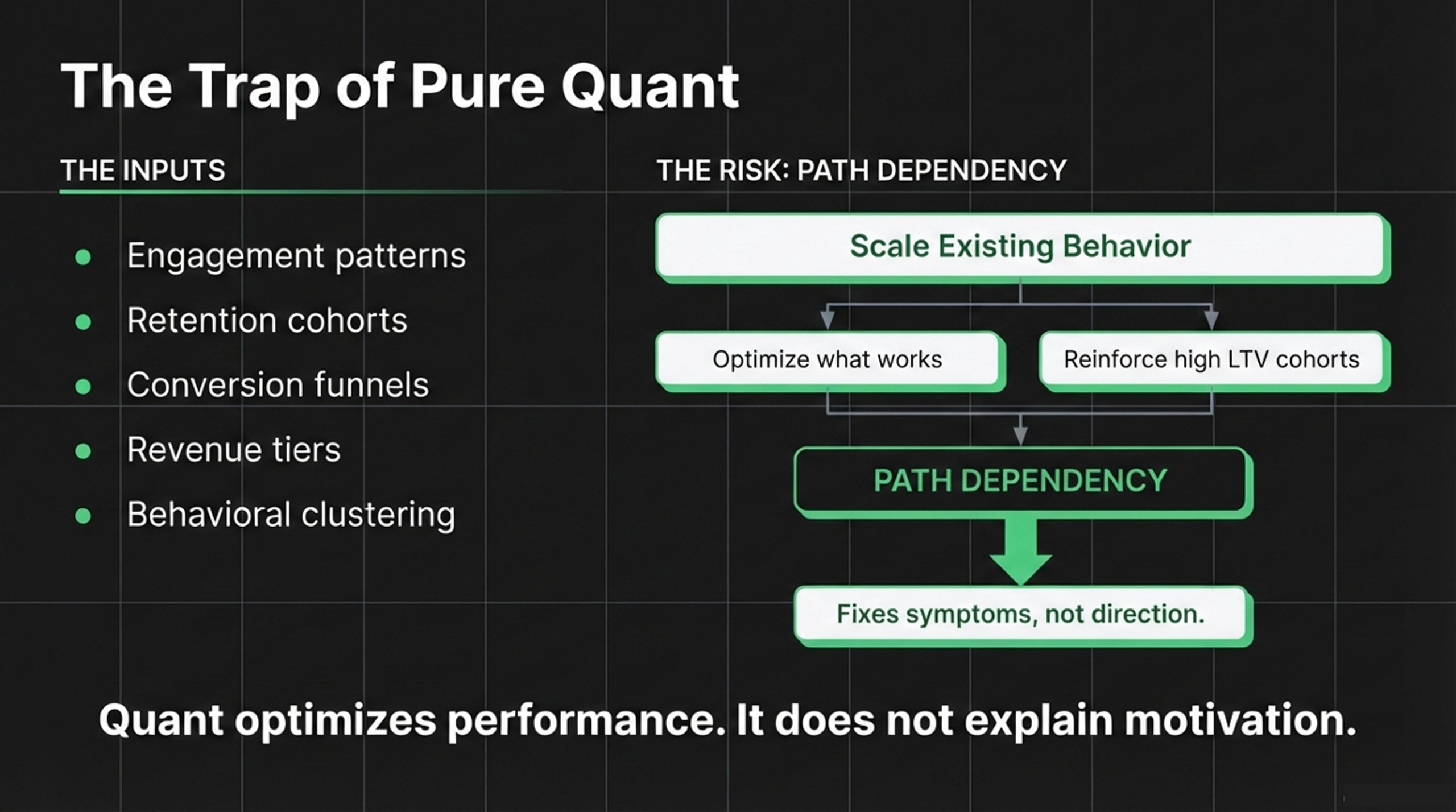
Consider a scenario where high-spending competitive players respond strongly to monetization offers. They engage deeply with ranked systems, invest in progression advantages, and show strong conversion behavior when competitive pressure is present. From a data perspective, this group is extremely valuable. Their behavior is visible, measurable, and directly tied to revenue.
As a result, the system begins to evolve around them.
More features are designed to support competitive play. Monetization systems are tuned to align with competitive advantage. Content updates prioritize mechanics that increase engagement for this group. Each individual decision is rational when viewed in isolation.
But collectively, these decisions begin to reshape the ecosystem.
Players who are not motivated by competition—those who value creativity, exploration, or relaxation—gradually find fewer entry points into the system. Their engagement becomes less visible in the data, which further reduces their influence on decision-making. Over time, the product shifts toward a narrower definition of value.
What makes this dynamic particularly difficult to detect is that the metrics continue to look strong. Revenue increases, engagement remains high, and key performance indicators suggest success. The system is optimizing effectively—but along a trajectory that may not align with the long-term vision of the product.
We optimize what already works, and in doing so, we gradually lose visibility into what is no longer being served.
The Limits of Segmentation
Segmentation is often introduced as a way to manage this complexity. By grouping players into cohorts—based on LTV, engagement, or behavioral patterns—we attempt to create a more structured understanding of the player base.
This is an essential capability. Without segmentation, it is difficult to reason about patterns at scale.
However, segmentation operates at the level of description, not explanation.
A segment such as “high LTV competitive players” provides clarity about what a group of players is doing and how valuable they are from a business perspective. But it does not explain why they behave that way, nor does it reveal how their experience relates to other types of players in the system.
This limitation becomes especially apparent when different segments exhibit similar behaviors for different reasons. Two players may fall into the same LTV tier, yet their motivations, expectations, and sensitivities to design changes may be entirely different.
Segmentation organizes behavior, but it does not capture intention.
From Data to Humans: The Role of Persona
Persona attempts to address this gap by reintroducing human context into the analysis. It transforms abstract behavioral patterns into narratives that reflect real player situations—how they play, when they play, what they feel, and what they are trying to achieve.
This translation is important because it allows teams to reason about trade-offs in a way that aligns more closely with player experience. A drop in retention is no longer just a metric change; it becomes a signal about frustration, confusion, or unmet expectations.
Data shows behavior. Persona explains intent.
However, Persona introduces its own challenge. While it enhances understanding, it does not inherently provide a mechanism for prioritization. Personas are often rich, nuanced, and numerous. Without a way to structure them into decision-relevant categories, they remain descriptive rather than actionable.
A Brief Step Back: What Bartle Already Taught Us
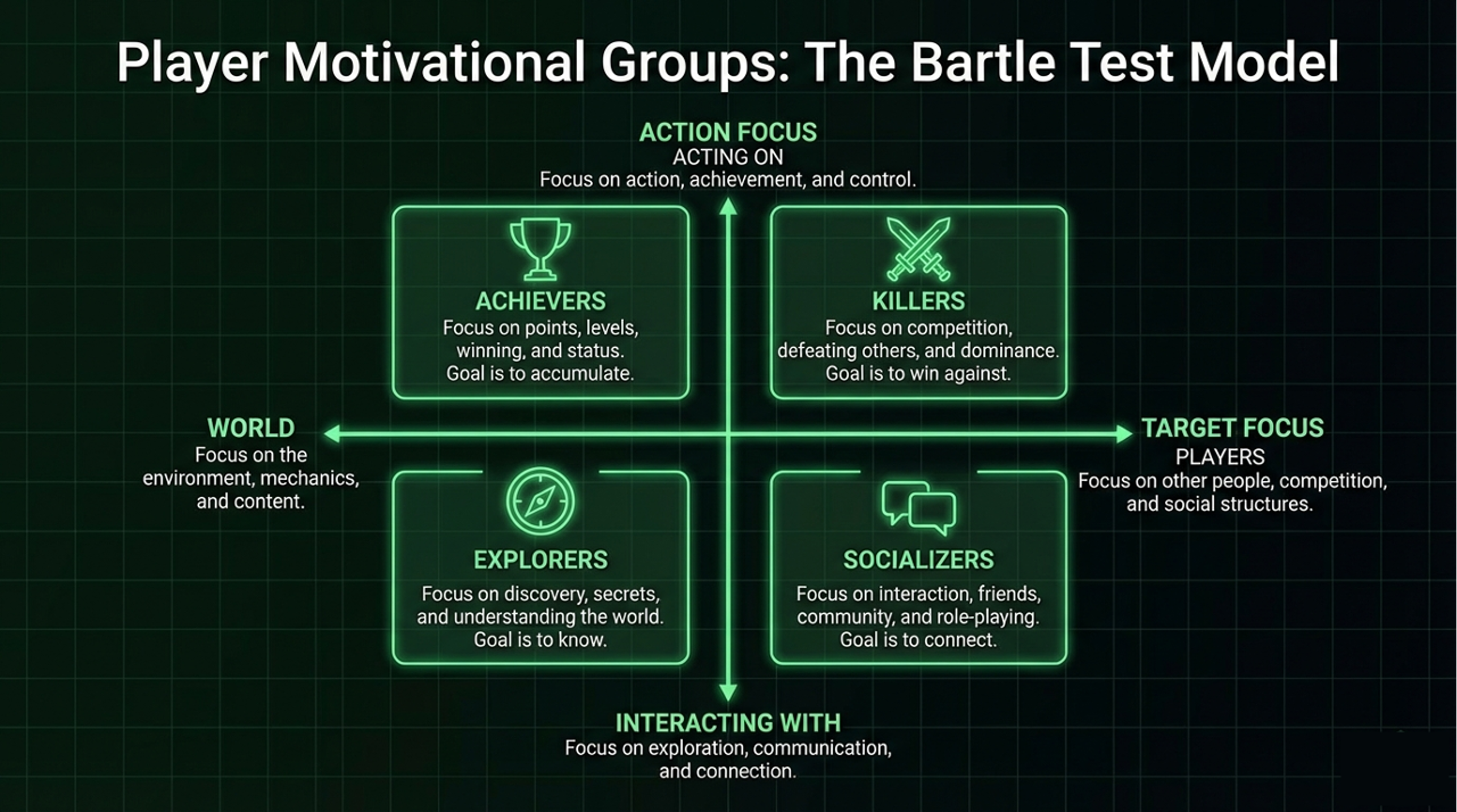
This tension between behavior and motivation is not new. Bartle’s player type model was one of the earliest attempts to formalize the idea that players engage with games for fundamentally different reasons. By identifying archetypes such as achievers, explorers, socializers, and killers, Bartle provided a framework for understanding diversity in player experience.
What is particularly important in Bartle’s work is not just the classification itself, but the recognition of interaction between player types. These archetypes do not exist in isolation; they coexist within the same system, influencing each other’s experiences.
A system that over-rewards achievers may create pressure that discourages explorers. A highly competitive environment may reduce the space for social interaction. These dynamics highlight that game design is not about optimizing a single player experience, but about balancing multiple, sometimes competing, motivations.
Games are ecosystems of motivations, not monolithic experiences.
From Insight to Structure: Motivational Groups
If segmentation helps us observe patterns and Persona helps us interpret them, the missing step is structure—something that translates understanding into a form that can guide decisions consistently.
This is the role of motivational groups.
Unlike predefined models, motivational groups are not universal. They must be constructed within the context of each specific game. Different games create different forms of engagement, and therefore require different ways of grouping player motivations.
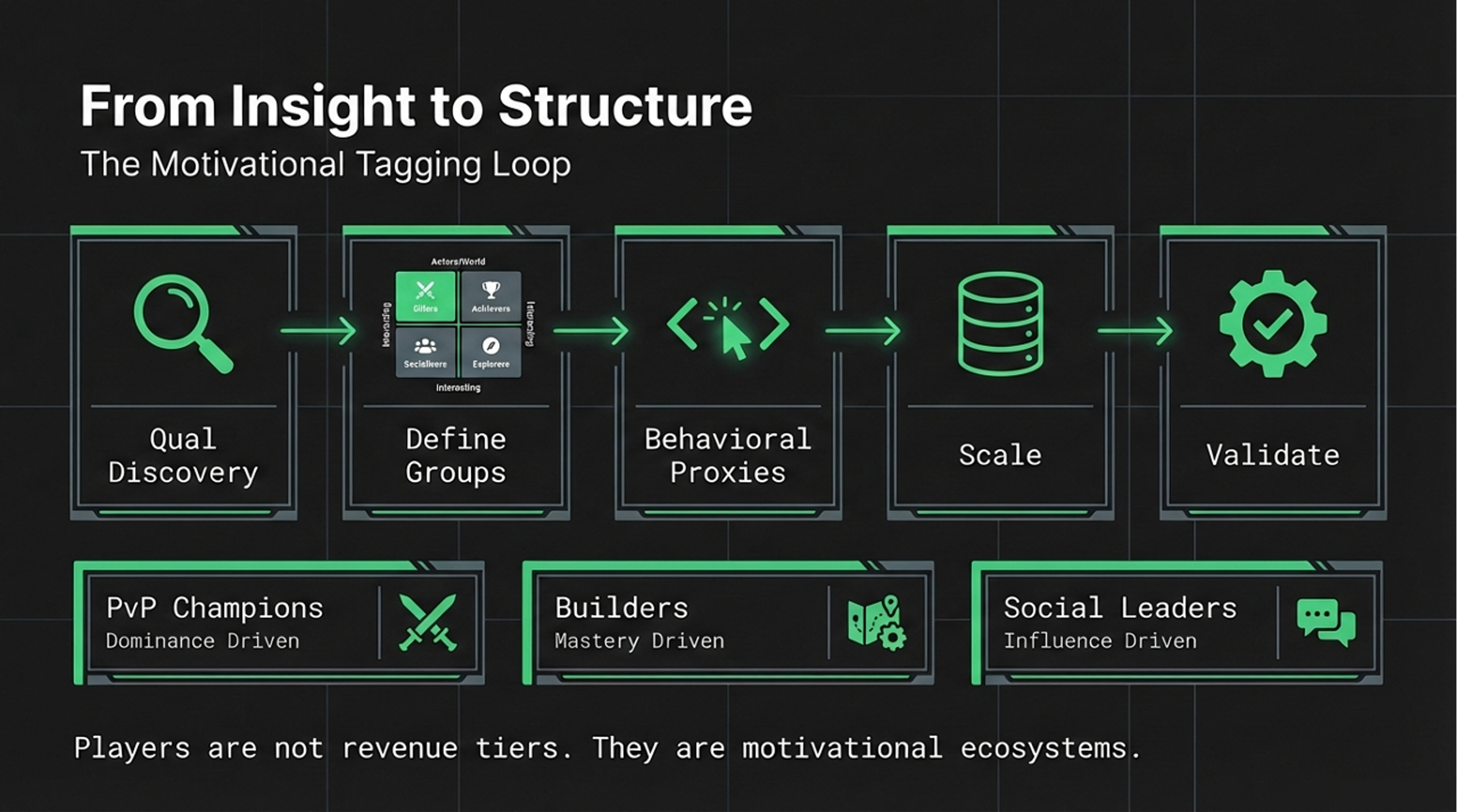
For example, in a game with a strong competitive core, one meaningful group might be “PvP Champions”—players who are deeply invested in competitive progression, who optimize their strategies around the meta, and who derive satisfaction from outperforming others. In another game, this group may not exist, or may be significantly less important.
The key is to define these groups in a way that is both conceptually meaningful and operationally useful.
This requires a translation step. Motivations must be linked to observable behavior. A PvP Champion is not just a conceptual label; it is reflected in patterns such as frequent participation in ranked matches, high engagement with optimization systems, and responsiveness to competitive incentives.
Once these behavioral proxies are defined, they can be used to tag players at scale and validated through quantitative data. Over time, this creates a loop between qualitative understanding and quantitative measurement.
Motivational groups are where qualitative insight becomes operational.
Players Are Not LTV Tiers
This framework also reframes how we interpret monetization data. LTV segmentation is valuable for understanding economic contribution, but it is insufficient for guiding design decisions.
Players with similar LTV can have fundamentally different relationships with the game. Their motivations shape how they perceive value, how they respond to systems, and how they react to changes.
Designing around LTV alone risks aligning the product with spending behavior rather than player experience.
Players may share economic value, but they rarely share experiential motivation.
The Missing Variable: Time Horizon
Another layer that complicates decision-making is time. Product discussions often blur the distinction between short-term optimization and long-term direction, even though these involve fundamentally different trade-offs.
Short-term decisions operate within the current system. They focus on improving metrics such as conversion, engagement, and retention. Long-term decisions, on the other hand, shape how the system evolves and how players perceive the product over time.
When these two horizons are not clearly separated, teams may optimize local performance while unintentionally shifting the overall trajectory of the game.
The Decision Matrix
To structure this, it is useful to think in terms of a matrix defined by two axes: data type (quantitative versus qualitative) and time horizon (short-term versus long-term).
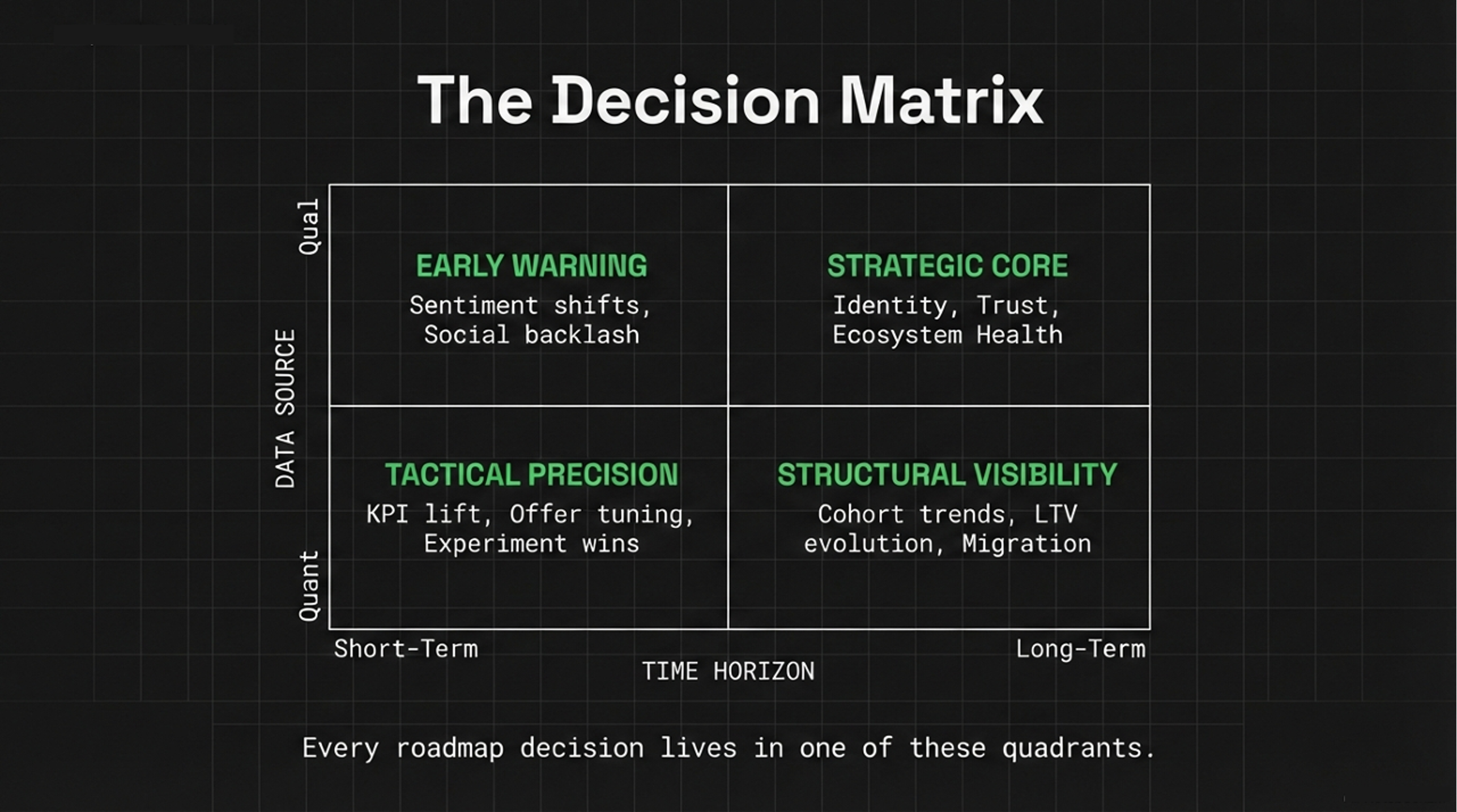
Short-term quantitative data provides immediate feedback on performance. It is precise, actionable, and essential for day-to-day optimization. However, its focus on local outcomes can lead to decisions that ignore broader system effects.
Long-term quantitative data reflects structural trends such as cohort survival and economy stability. It helps identify systemic issues, but it is inherently lagging. By the time these signals become clear, the underlying player perception may have already shifted.
Players may continue playing even when their perception of the game has already changed.
Short-term qualitative signals act as early indicators of friction. They reveal issues that may not yet appear in metrics, but they are also noisy and require careful interpretation.
Long-term qualitative understanding captures player identity and trust. It defines how players interpret the game and what they believe it represents. This layer is critical for strategic direction, but it is also the most difficult to measure and requires strong judgment.
Tactical decisions can be driven by short-term quant, but strategic decisions must be grounded in long-term qualitative understanding.
From Features to Ecosystems: Roadmap as Investment Portfolio
When we integrate these perspectives, the way we think about roadmaps fundamentally changes.
Instead of viewing features as isolated units competing for ROI, we begin to see the roadmap as a portfolio of investments within a dynamic system. Each feature contributes not only to metrics, but to the balance of motivations within the ecosystem.
This shifts the order of decision-making. Rather than starting with revenue impact, we begin with product identity—what kind of experience the game is meant to provide. We then evaluate whether different motivational groups are being supported in a balanced way. Next, we assess long-term system health. Only after these layers are considered do we optimize for short-term performance.
A roadmap is not a collection of features; it is a long-term allocation of attention across player motivations.
Motivation as the Shared Language
One of the most practical benefits of this framework is alignment. Different teams within an organization often operate with different mental models and priorities. Analytics focuses on measurable outcomes, design focuses on experience, and community focuses on sentiment and trust.
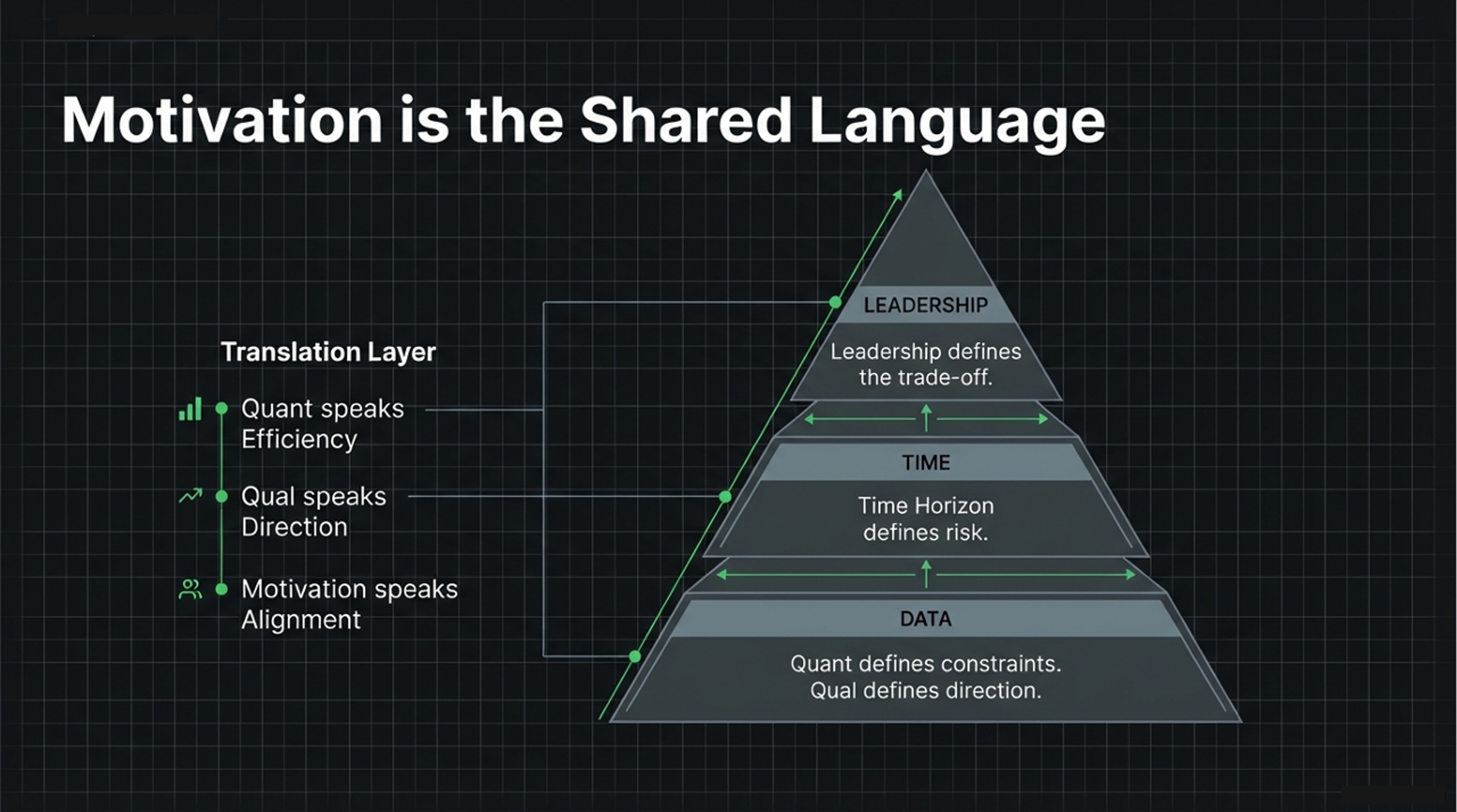
Motivation provides a common language that connects these perspectives. It links behavior, intent, and system design into a unified framework that can support consistent decision-making.
Conclusion: From Signals to Strategy
Ultimately, great roadmaps are not the result of optimizing metrics alone. They emerge from the ability to interpret signals within a broader understanding of player behavior, motivation, and identity, and to translate that understanding into consistent decisions over time.
Metrics follow behavior.
Behavior follows motivation.
Motivation follows identity.
And identity is shaped by long-term decisions.
That is how we move from signals to strategy.